

Where Can I Learn About Japanese Hibachi Cuisine?
- Paul Yu
- Aug 4
- 3 min read

The short answer is that you should learn about two different things, because "hibachi" in America refers to a Japanese-influenced restaurant format called teppanyaki rather than to a Japanese cuisine.
Learn the Japanese tradition and the American format separately and both make more sense. Here's where to start on each.
Start with the vocabulary, because it's the main confusion
Hibachi is 火鉢, literally "fire bowl" — an open ceramic or metal container holding charcoal, used in Japan primarily for heating. Some were used for light grilling, but warmth was the job.
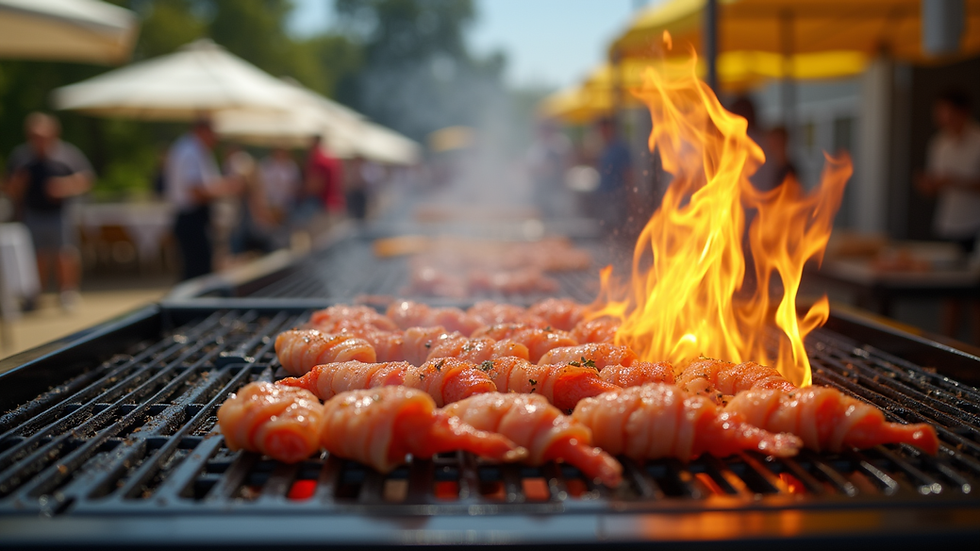
Teppanyaki is 鉄板焼き, "iron plate grilled" — a large flat steel griddle with a chef cooking on it directly. That is what happens at an American hibachi restaurant, and what a mobile hibachi chef brings to a private event.
A Japanese speaker watching one of our events would call it teppanyaki. Nobody there would call the griddle a hibachi. The American usage traces to Benihana, which opened in New York in 1964 and popularized the teppanyaki format; the word attached itself to the wrong object and stuck.
Where to learn the Japanese tradition
If you want the real culinary background rather than the restaurant version, a few starting points.
Shizuo Tsuji, "Japanese Cooking: A Simple Art" — the canonical English-language reference on Japanese technique, and the book most Western chefs learn from. Teppanyaki sits inside the tradition it describes.
Anything on teppanyaki as practiced in Japan, which is often a high-end format built around expensive beef, restrained presentation, and minimal performance — closer to a chef's counter than a party.
Charcoal grilling traditions like yakitori and robatayaki, which are nearer to what an actual hibachi was used for than anything on a flat top.
Worth knowing going in: the American version is its own thing. Yum-yum sauce is essentially an American invention. The volume of fried rice, the tricks, and much of the theater grew up here. That isn't a criticism — it's a format that adapted to a different audience and became something people genuinely love. But if you study Japanese teppanyaki expecting to recognize an American hibachi party, you won't.
Where to learn the American format
This one is learned by watching and doing more than by reading, and the sources that exist are mostly practical.
The cooking itself is simpler than people expect. Soy sauce, garlic, butter, oil, ginger, sesame. Flavor comes from the sear and the butter far more than from complex seasoning. What's hard is heat management — a flat surface running north of 600°F divided into zones at different temperatures, with proteins, rice, noodles, and vegetables all moving through at once so a room eats together.
The three sauces are worth knowing by name. Yum-yum is the creamy pink-orange one, mayonnaise-based with tomato, butter, paprika, and garlic. Ginger sauce is thin and sharp, built on fresh ginger and onion, and cuts the butter. Mustard or sesame sauce is nuttier and more assertive.
The fried rice has to be made from day-old rice. As cooked rice cools, the starch recrystallizes and pulls moisture inward, leaving the grain surfaces dry enough to sear instead of steam. Fresh rice clumps and turns to paste on a griddle.
If you want to learn it to cook it
A few honest notes from doing this professionally.
You can't replicate it on a home range. The entire format depends on a large flat surface holding very high heat under load, and a domestic burner under a pan does neither. A flat-top griddle attachment gets you closer than a skillet.
The tricks are harder than they look. Try stacking an onion volcano with a spatula in your own kitchen, with nobody watching. That's the honest test of whether the theater is skill or filler.
And most of the craft is timing rather than technique. Cooking one good steak isn't difficult. Cooking twenty so twenty people eat together, at the right doneness, with the sides ready alongside — that's the actual job, and it's what takes years.
If you'd rather just eat it
We cook hibachi at private events across Rhode Island, southeastern Massachusetts, and eastern Connecticut, from commercial kitchens in Cranston and Providence. If you're curious about the format, watching a chef work a full griddle for an evening teaches more than any article — including this one. We've also written in more depth on hibachi vs. teppanyaki and what hibachi cooking actually is.
SIFU Hibachi & Sushi Catering — kitchens in Cranston and Providence, RI.
Comments