

Hibachi vs. Teppanyaki: What Americans Actually Mean
- Paul Yu
- Aug 3
- 4 min read

Short answer: what Americans call hibachi is technically teppanyaki. A real hibachi is a charcoal heating bowl, not a grill you cook dinner on in front of guests.
That's the correction you'll get from any encyclopedia. Here's the part encyclopedias leave out — why the wrong word won, and whether it matters when you're booking one.
What the two words actually mean
Hibachi is 火鉢, literally "fire bowl." It's an open-topped ceramic or metal container that holds burning charcoal. In Japan it was a heating device — you sat near one in winter. Some were used for light cooking, grilling small things over the coals, but its job was warmth.
Teppanyaki is 鉄板焼き, "iron plate grilled." A large flat steel griddle with the chef cooking on it directly. That's the format with the flat surface, the spatulas, and the chef working in front of you. That is what happens at an American hibachi restaurant.
So a Japanese speaker watching one of our events would call it teppanyaki. Nobody there would call our griddle a hibachi.
Why the wrong word stuck in America
Benihana opened in New York in 1964 and brought the teppanyaki format to an American audience — chef at the table, knife work, food cooked in front of you. It became enormously popular, and as it spread, "hibachi" became the shorthand Americans used for the whole experience.
Part of it is that early Japanese restaurants in the US sold hibachi-style charcoal grills alongside the meal, and the word attached itself to the wrong object. Part of it is simply that hibachi is easier for an English speaker to say than teppanyaki.
Sixty years on, the usage is settled. If you tell an American caterer you want teppanyaki, you'll get the same event you'd get asking for hibachi. Language does this — the word that wins isn't always the accurate one.
Does the distinction matter when you're booking?
Mostly no, and I'd be suspicious of anyone who makes a big deal of correcting you. If you ask ten caterers in New England for hibachi, ten of them know exactly what you want.
Where it does matter is equipment, and that's worth understanding before you compare quotes.
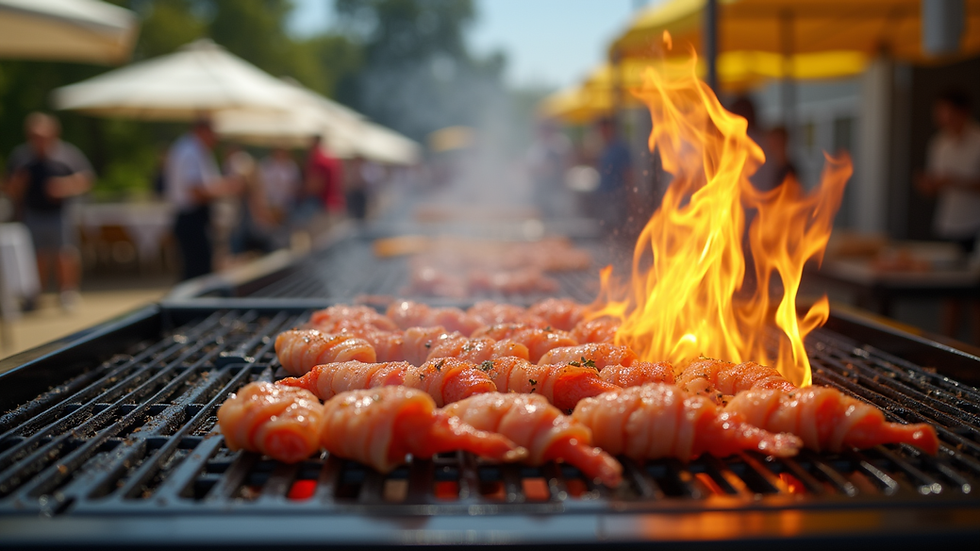
Teppanyaki is a flat griddle. Heat is even across a large steel surface, which is what makes it possible to cook for a room at once and keep everything moving. A charcoal grill — an actual hibachi — has grates, uneven heat, and a fraction of the working surface. You cannot cook fried rice on grates.
So if a caterer shows up to a hibachi booking with a charcoal grill or a domestic barbecue, that is a real problem, and it's the one case where the terminology confusion causes actual harm. Ask what surface they cook on. The answer should be a flat steel griddle.
What the format is actually built around
Teppanyaki is designed to solve one problem: cooking for a group in front of them without anyone waiting.
The flat surface means multiple proteins, rice, noodles, and vegetables all cook at once in separate zones at different temperatures. The chef manages timing across the whole griddle so a table of eight eats together rather than in sequence. That's the real skill, and it's why the format exists.
The theater — the onion volcano, the flying spatula, the egg trick — grew up alongside it. It's not separate from the cooking. A chef running tricks while managing three proteins across a full griddle is demonstrating control of their station, which is exactly what you want to see.
Is American hibachi authentic Japanese food?
Honestly, it's its own thing, and pretending otherwise doesn't do anyone favors.
Teppanyaki in Japan is often a high-end format — expensive beef, restrained presentation, minimal performance. The American version added the show, the yum-yum sauce, the volume of fried rice, and a lot of the theater. Yum-yum sauce in particular is essentially an American invention; you won't find it standard in Japan.
That's not a criticism. It's a format that adapted to a different audience and became something people genuinely love. But if you're booking hibachi expecting a Kyoto teppanyaki counter, you're booking the wrong thing, and if you're booking expecting the American experience, that's what you should get done well.
So what should you call it?
Call it hibachi. Everyone will know what you mean, including us.
Just know that what you're getting is teppanyaki — a flat steel griddle, a chef cooking in front of your guests, and food that comes off the surface hot rather than sitting in a tray. That's the thing worth paying for.
How we run it
We cook on flat steel griddles running north of 600°F, with a chef and a dedicated attendant at every event. Every guest gets chicken, steak, and shrimp — not pick-one — plus fried rice, noodles, vegetables, salad, and edamame. If you want the detail on what separates a good setup from a bad one, we wrote about what makes good hibachi catering, and on what mobile hibachi actually costs.
SIFU Hibachi & Sushi Catering — Cranston, RI. Serving Rhode Island, southeastern Massachusetts, and eastern Connecticut.
Comments