

What Makes a Good Hibachi Chef?
- Paul Yu
- Aug 3
- 5 min read

A good hibachi chef controls heat, controls timing, and controls the room — usually at the same time. The tricks are the part guests remember, but they're the easiest thing on that list to learn.
I hire and train these people. Here's what actually separates a chef I'll put in front of your family from one I won't.
Heat control is the whole job
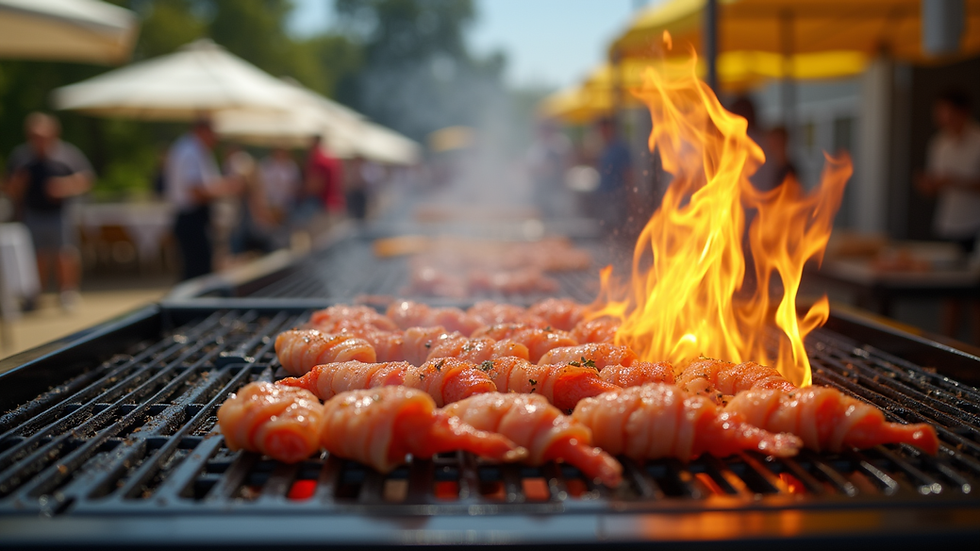
A hibachi griddle is a single flat surface running north of 600°F, and everything for the entire party cooks on it at once.
A good chef divides that surface into zones — a searing area for proteins, a cooler section for rice and noodles, another for vegetables — and holds all of them at the right temperature while food moves through. Rice needs a surface that won't scorch it. Steak needs one that will sear on contact. Those are different temperatures, six inches apart, managed by hand.
You can spot a chef who doesn't have it. Food comes off gray instead of browned, because the protein released moisture faster than the surface could drive it off and ended up poaching. Or the rice catches and turns bitter. Or the vegetables sit limp while the steak finishes.
Everything else on this page is secondary to that one skill.
Timing across a whole party, not a single plate
Cooking one good steak isn't difficult. Cooking twenty so that twenty people eat at the same time, at the right doneness, with rice and vegetables ready alongside — that's the actual job.
A hibachi meal has a sequence. Salad and edamame go out while the griddle heats. Vegetables and fried rice come next, because they hold. Proteins come last and go straight from griddle to plate.
A chef who loses that sequence produces a party where half the guests are eating and half are waiting. Nobody complains out loud, but everybody notices.
Reading the room
This is the hardest part to teach, and it's what separates a good line cook from a good hibachi chef.
A backyard fortieth birthday with a lot of drinking wants a loud chef. A corporate dinner where people are talking business wants a chef who cooks well and stays out of the conversation. A party with small kids wants someone who slows down, involves them, and knows when the flames are too much.
Same menu, same griddle, three completely different performances. A chef who runs the identical routine at all three is performing at the room rather than for it.
Knife skills can be trained. This is much harder to train, and it weighs heavily in who I keep.
How guests get treated
Cooking three feet from people — with a 600-degree surface, open flame, and knives — in a backyard where there are kids and guests holding drinks, is as much a people job as a cooking job.
Customer interaction is the main thing I watch in a new chef. How they talk to guests. Whether the banter stays warm instead of turning sharp or awkward. How they handle a child who wants to get closer, or a guest who's had a few and wants to be part of the show. Whether they know when to pause rather than push through because the routine says so.
A chef who reads people well keeps a party safe almost automatically, because they're paying attention to where everyone is. A chef who only watches the griddle doesn't.
There's one call I don't leave to individual judgment. Burning propane in an enclosed space produces carbon monoxide, so we don't run propane indoors — ever. For indoor winter events we bring an electric griddle and our own battery power, and no chef of ours gets to decide otherwise on site because a host asked nicely.
How a chef earns a customer event here
New chefs cook for our staff before they cook for a customer.
It sounds simple and it tells me almost everything. Can they hold heat across a full griddle. Do the proteins come off seared or gray. Is the rice separate or clumped. Do they keep pace when people are waiting. And they're cooking for a room of people who do this for a living, which is a harder audience than any birthday party.
It also sets the standard on day one. What I tell my staff is one sentence: if you wouldn't put it in your mouth, don't give it to the customer. Having a new chef feed the people who'll hold them to that makes the point better than any explanation.
Nothing gets wasted either. A plate that doesn't meet the bar doesn't go out and doesn't go in the trash — staff eat it. A cook who has to eat their own rejected work learns faster than one who gets a lecture.
The tricks are real skill — and also a signal
Try stacking an onion volcano at home with a spatula sometime. Then try it with forty people watching and dinner cooking underneath it.
The theater is harder than it looks. But its real value to you as a customer is as a proxy: a chef running tricks fluidly while managing three proteins across a full griddle has spare capacity. Their hands are ahead of the food.
A chef who skips the show usually isn't skipping it by choice. They're using everything they have just to keep up.
Consistency at the end of the night
Anyone can cook well for the first ten plates.
The test is guest thirty. Is the griddle still holding heat? Is the chef still doing the show, or just getting food out? Does the last person served eat as well as the first?
This is why we cap one chef around 30 guests and send two chefs and two grills past 40 — not one chef working two rounds. Past a point it isn't a skill problem, it's arithmetic. There's only so much surface and only so many hands.
It's also why we schedule four hours apart per chef. A chef with another party to get to is a chef cutting corners at the end of yours, and no amount of skill fixes that.
How to tell before you book
You can't watch someone cook before hiring them, so ask questions that get at the same things.
How many events is the chef doing that day? Stacked bookings mean a rushed party.
How many chefs and grills for my guest count? Past 30 guests, one of each isn't enough.
Is there a separate server? One person cooking and plating means slower food and often no cleanup.
If we need to be indoors, what's the setup? The answer should be electric or properly ventilated — not a shrug.
Are the chefs employees, or dispatched? Booking networks send whoever is free that night, and consistency is exactly what you can't guarantee that way.
That last one matters more than people realize. Our chefs are our staff, trained to one standard out of one kitchen in Cranston. Book us twice and you get the same bar twice.
Our chefs
We cook at private events across Rhode Island, southeastern Massachusetts, and eastern Connecticut, with a chef and a dedicated attendant at every event. For more on judging a caterer rather than a chef, we wrote about what makes good hibachi catering and booking a hibachi chef in Rhode Island.
SIFU Hibachi & Sushi Catering — Cranston, RI.
Comments