

Mobile Hibachi Show for Events in Massachusetts
- Paul Yu
- Aug 4
- 5 min read

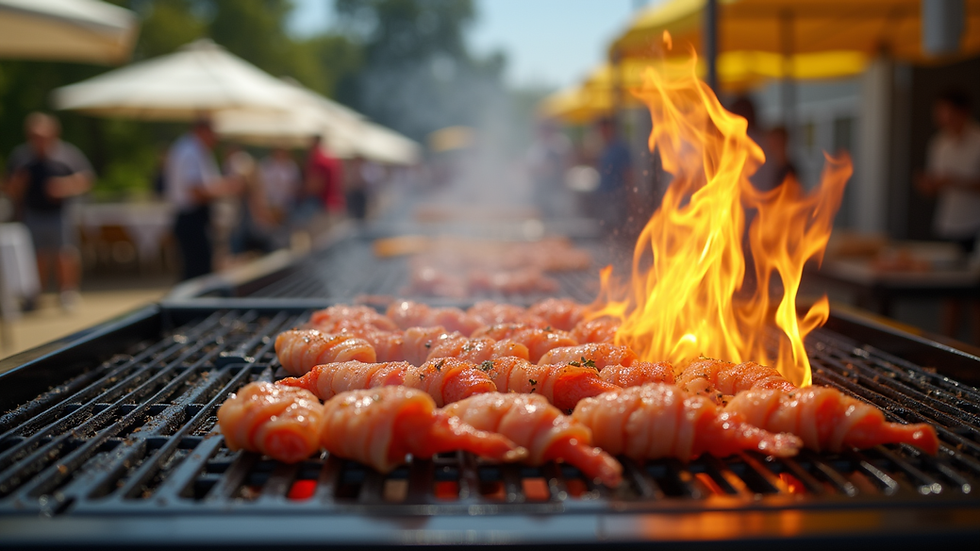
The show is the reason people book hibachi instead of ordering catering. A chef cooking on a 600-degree griddle three feet from your guests, with knife work and fire and food flying — that's the product. The dinner comes with it.
But the show isn't a separate act bolted onto the cooking, and understanding why tells you a lot about which caterer to book.
What makes the best hibachi show?
The best hibachi show comes from a chef who has capacity to spare. Everything else follows from that.
A chef cooking at the edge of what they can handle will get food out, and that's all. The tricks, the timing of the patter, the attention paid to which guest is enjoying it and which one wants to be left alone — all of that requires hands and attention that aren't already committed to the griddle.
Which means the best show is largely decided before anyone arrives, by three things: how many guests one chef is cooking for, whether that chef has another party to reach afterward, and whether someone else is handling plating and service. Get those three right and a competent chef performs well. Get them wrong and a brilliant chef can't.
The rest of this page is what each of those looks like in practice, and what to ask a caterer about them.
What the show actually is
The standard repertoire is familiar because it works: the onion volcano, spatula and knife flips, food tossed to guests who try to catch it in their mouths, egg tricks, and flame work over the griddle. Most chefs have their own variations and their own patter.
What people underestimate is that all of it happens while dinner is being cooked. The tricks are performed with the same hands, on the same surface, at the same time as timing three proteins, fried rice, noodles, and vegetables across different heat zones so that everyone eats together.
It isn't a performance with cooking in the background. It's cooking with a performance layered on top, and the second part only works if the first part is under control.
Why it's harder than it looks
Try stacking an onion volcano at home with a spatula. Just that one piece, in your own kitchen, with nobody watching.
Then imagine doing it with forty people looking at you and dinner cooking underneath it.
That's the honest test of whether the theater is skill or filler. It's skill. And more usefully for you as a customer, it's a signal — a chef running tricks fluidly while managing a full griddle has spare capacity. Their hands are ahead of the food.
A chef who skips the show usually isn't skipping it by choice. They're using everything they have just to keep up.
The two things that kill the show
Both are booking decisions made before the chef ever arrives, which is why they're worth asking about.
Stacked bookings. A lot of mobile hibachi chefs run several parties in an evening, back to back. That chef is watching the clock at your event. The show gets trimmed first, because it's the part that takes time and doesn't feed anybody. Then breakdown starts while your guests are still eating.
We schedule four hours apart per chef. Nobody at your event is trying to get somewhere else.
Too many guests for one chef. A single chef on a single griddle tops out around 30 people. Past that the show is the first thing to go, because getting food out becomes the only priority. Past 40 guests we send two chefs and two grills running at the same time — not one chef working two rounds — so the performance holds for the whole room.
The best chefs read the room
This is the part that separates a good performer from a good hibachi chef, and it's the hardest thing to train.
A backyard fortieth birthday with a lot of drinking wants a loud chef. A corporate dinner where people are talking business wants a chef who cooks well and stays out of the conversation. A party with small kids wants someone who slows down, brings them into it, and knows when the flames are too much.
Same menu, same griddle, three completely different performances. A chef who runs the identical routine at all three is performing at the room rather than for it.
When we bring on a new chef, how they interact with guests is the main thing we watch. Whether the banter stays warm instead of turning sharp. How they handle a kid who wants to get closer, or a guest who's had a few and wants to be part of the act. Whether they pause when they should, rather than pushing through because the routine says so.
Where the show has to stop
A backyard is not a restaurant. There are children, people holding drinks, pets, low branches, patio furniture, and a chef running open flame and 600-degree steel in the middle of it.
A chef reading the room well keeps the party safe almost automatically, because they're already tracking where everyone is. A chef watching only the griddle isn't.
There's one call we don't leave to individual judgment. Burning propane in an enclosed space produces carbon monoxide, so we don't run propane indoors — ever. For indoor and winter events we bring electric griddles and our own battery power, so we're not putting combustion inside your house and not relying on your circuits.
If a caterer agrees to set up in your closed garage in January without hesitating, that tells you how they weigh a booking against a risk.
How the show fits the meal
A hibachi meal has a rhythm. Salad and edamame go out while the griddle heats and guests are arriving. Vegetables and fried rice come next, because they hold. Proteins come last and go straight from griddle to plate.
The theater runs through all of it rather than sitting in one block — the volcano near the start, tricks between rounds, food tossed to guests while things cook. Nobody is standing around waiting for a performance to finish before dinner starts.
What to ask before you book
How many events is the chef doing that day? Stacked bookings mean a trimmed show.
How many chefs and grills for my guest count? Past 30 guests, one of each isn't enough for the performance to survive.
Is there a separate server? A chef who also has to plate and serve has no spare capacity for anything else.
If we're indoors, what's the setup? The answer should be electric or properly ventilated.
Are the chefs employees or dispatched? Booking networks send whoever is free that night, so the performance you get is whoever turns up.
Booking a hibachi show in Massachusetts
We work from commercial kitchens in Cranston and Providence, Rhode Island, and cover southeastern Massachusetts — Fall River, New Bedford, Attleboro, Taunton, Seekonk, Rehoboth, Swansea, Somerset, Dartmouth, Mansfield, Franklin, Milford, and Brockton among them.
Signature Hibachi starts at $800 for up to 20 guests, about $40 a head, with chicken, steak, and shrimp for every guest and a chef plus a dedicated attendant at every event. Text or call with your date, town, and guest count for a flat quote.
Call or text 401-402-9616.
More on judging a chef is in what makes a good hibachi chef, and large-event staffing is covered in mobile hibachi for large events in Massachusetts.
SIFU Hibachi & Sushi Catering — kitchens in Cranston and Providence, RI.
Comments